Onko kiinnostusta?
-Tiina
From: Sirpa Salo Sent: 2. marraskuuta 2012 11:20 To: Kalervo Metsikkö; Eero Kouvalainen; Pirkko Viitala; Katja Porvari; Virpi Glumoff; Tiina Hurskainen; Emma Pirilä; Seppo Vainio; Aki Manninen; lauri.eklund@oulu.fi Cc: Pertti Vuokila Subject: Milliporen Direct Detect - mahdollisia käyttäjiä ja laitteen demo?
Hei kaikki,
Harkitsemme Milliporen Direct Detect –laitteen hankkimista tänne lääketieteellisen biokemian laitokselle. Todennäköisesti hankinta tehtäisiin Solun ja soluväliaineen huippuyksikön budjetista, jos budjetti antaa siihen mahdollisuuden nyt loppuvuonna.
Sami Sivonen Merck Milliporelta on mahdollisesti järjestämässä laitteen demoa tänne Ouluun jo nyt syksyllä, mahdollisesti piakkoinkin ke 28.11.2012. Ennen hankintapäätöstä yritämme hieman kartoittaa mahdollisen käyttäjäkunnan laajuutta koko lääkiksen kampuksella. Voisitteko siis hieman selvitellä yksiköissänne tutkijoiden ja laboranttien mahdollista kiinnostusta ko. laitteeseen?
Alla on hieman lisää infoa. Toivottavasti ehditte laittaa viestiä, jos laite kiinnostaa tai jos ei kiinnosta. Kiitos etukäteen.
t. Sirpa
Sirpa Salo Projektipäällikkö, FT Solun ja soluväliaineen tutkimuksen huippuyksikkö Biolääketieteen laitos Lääketieteellinen biokemia ja molekyylibiologia PL 5000 90014 OULUN YLIOPISTO
Puhelin: 029 448 7590 (sis. 487590) Sähköposti: sirpa.salo@oulu.fimailto:sirpa.salo@oulu.fi Internet: www.oulu.fi/cecerhttp://www.oulu.fi/cecer
About Direct Detect: http://www.millipore.com/life_sciences/flx4/direct_detect?open&cid=bios-...
The Millipore Direct Detect instrument is for protein quantitation assay. It detects the amide bond using infra-red spectrometry. It does not need sample prep, standard curves, cuvettes or liquid. It works in the presence of detergents and reducing agents. It also detects other biomolecules, including nucleic acids, lipids and carbohydrates, thus providing a broader range of biomolecular detection. The measurement requires only 2 µL per analysis.
One important advantage for our studies is to normalize the total protein loading amount in western blotting and immuno precipitation. Triton and SDS in these samples interfere the protein concentration analyses using other protein assays.
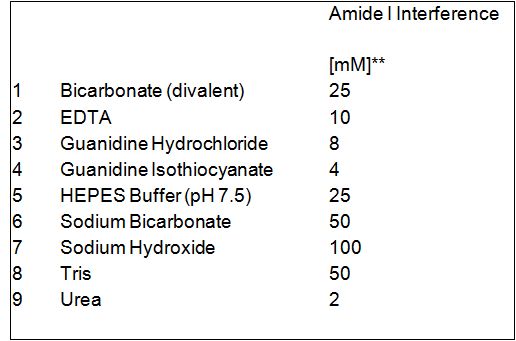
The disadvantage is that some buffers containing chemicals with amide bonds, such as urea, Tris, etc. interfere the measurement in Direct Detect. The interference concentration is listed below:
[Description: cid:_1_0E06BB880E06B7580029071CC2257A21]
All the other common buffers, such as PBS, SDS, DTT, etc. are ok
The company has compared with other protein assays: Quantitation Approach
Assay Range
Sample Volume (tube/plate)
Amount Protein Required to Measure 1 mg/mL
Compatible
Incompatible
Direct Detect™
200-5,000 µg / mL
5 µL
6 µg
Detergents Reducing agents SDS Chelators
(High) Urea
Bradford Assay
100-1,500 µg / mL
35 µL / 7 µL
21 µg
Most reducing agents Chelators
Detergents
BCA Assay
20-2,000 µg / mL
50 µL / 25 µL
30 µg
Detergents
Reducing agents Chelators
Micro BCA™ Assay
2-40 µg / mL
500 µL / 150 µL
450 µg
Detergents
Reducing agents Chelators
Lowry Assay
10-1,500 µg / mL
200 µL / 40 µL
120 µg
SDS
Detergents Reducing agents Chelators
More info: http://www.millipore.com/life_sciences/flx4/direct_detect?open&cid=bios-...